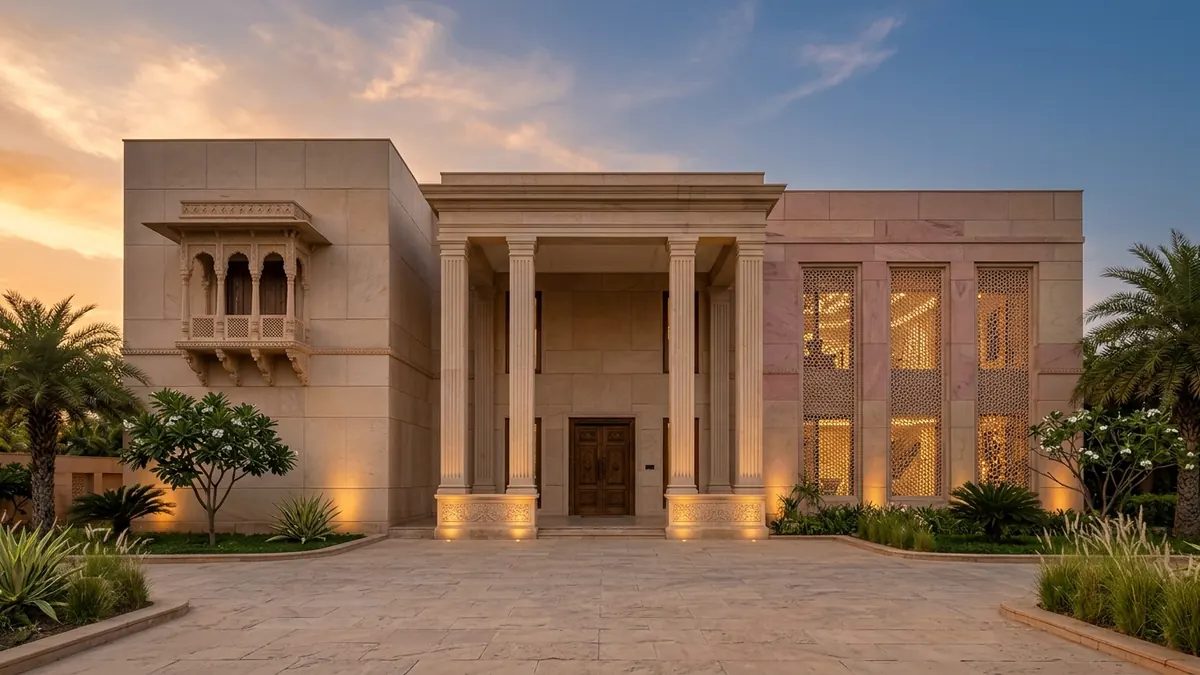

Walk past any five-year-old painted bungalow after three heavy monsoons and you will spot damp blisters, hairline plaster cracks, and faded west-facing walls. Choosing natural sandstone facade cladding solves exterior maintenance permanently while giving an independent residence architectural weight that stucco or synthetic tiles can never fake.
From Lutyens Delhi bungalows and Jodhpur palaces to contemporary cantilevered villas in Hyderabad and Ahmedabad, Rajasthani sandstone has proven itself across six centuries of extreme Indian weather. Whether your aesthetic leans toward royal haveli jharokhas or clean neoclassical limestone-toned cornices, engineering the stone thickness and fixing method properly guarantees lifetime safety and thermal comfort.
Natural sandstone facade cladding (in Dholpur Beige, Pink, or Red) outlasts exterior paint and ACP sheets by decades while reducing indoor summer wall heat transfer by 3°C to 5°C when installed over an SS-304 or SS-316 dry mechanical cladding cavity above 3 metres height.
- Dry mechanical clamping with SS-304 (inland) or SS-316 (coastal) cramps creates a 35-50 mm ventilated air cavity that slashes solar heat gain.
- Never rely solely on wet cement mortar above 10 feet elevation; thermal cycling loosens mortar bonds over time.
- Carved sandstone jaalis act as Venturi cooling screens, accelerating breezes while maintaining complete daytime visual privacy.
- Zero repainting lifecycle: periodic pressure-washing every 5-7 years keeps sandstone elevations crisp for generations.
In This Architectural Guide
1. Dry Mechanical Cladding vs Wet Mortar Cladding
How sandstone attaches to your RCC and brick structure matters even more than the stone colour itself. In traditional wet cladding, masons apply polymer-modified tile adhesive or cement slurry directly behind 18-20 mm stone slabs. While acceptable on low boundary walls or ground-floor plinths up to 8 or 10 feet, wet fixing traps moisture behind the stone, causing white efflorescence salt stains and risky debonding on upper floors.
Modern luxury residences use dry mechanical cladding using heavy-duty Stainless Steel 304 (or marine-grade SS-316 near Mumbai, Goa, or Chennai coasts) Z-cleats and anchor bolts with minimum 25 mm to 30 mm thick sandstone slabs. Because each slab hangs independently with 4 mm movement joints, structural expansion never cracks the stone.
- Passive Thermal Insulation: The 40 mm air gap behind dry-clad sandstone creates a natural chimney effect, venting hot air upward and lowering AC cooling loads on west and south walls.
- Zero Efflorescence: No wet cement contact means zero alkaline salt bleeding onto honed beige or pink sandstone surfaces.
- 3D Carved Element Integration: Heavy cornices, column capitals, window surrounds, and projecting chhajjas tie directly into RCC beams via concealed stainless steel pins.
View Bespoke Heritage & Classical Sandstone Elevations
Explore custom-milled columns, cornices, jharokhas, and dry-clad stone envelopes crafted at quarry scale.
2. Selecting Between Heritage and Neoclassical Sandstone Palettes
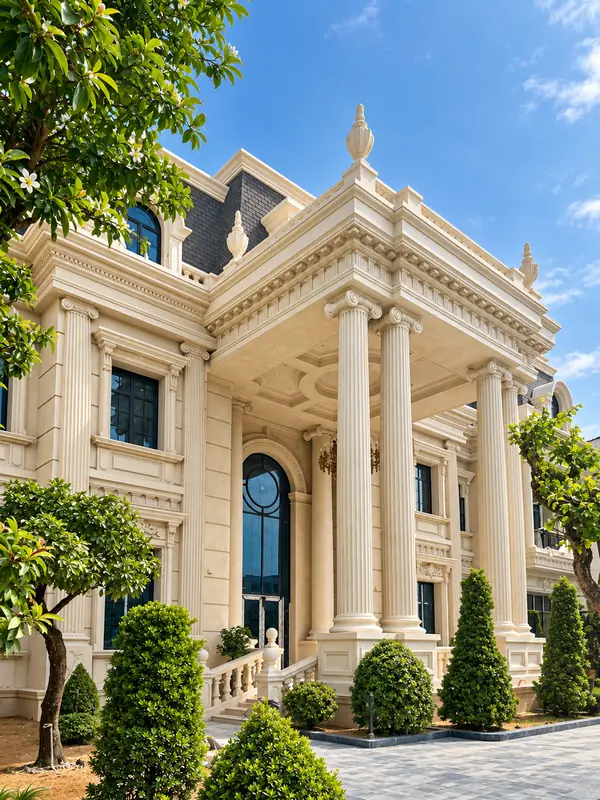
Architects categorize elevation palettes by how light interacts with regional stones. If your brief calls for classical symmetry, fluted pilasters, balustrade railings, and European-inspired proportions, honed Dholpur Beige Sandstone and Mint White Sandstone deliver a calm, creamy monochrome envelope. Explore full architectural assemblies in our Classical Facade Collection.
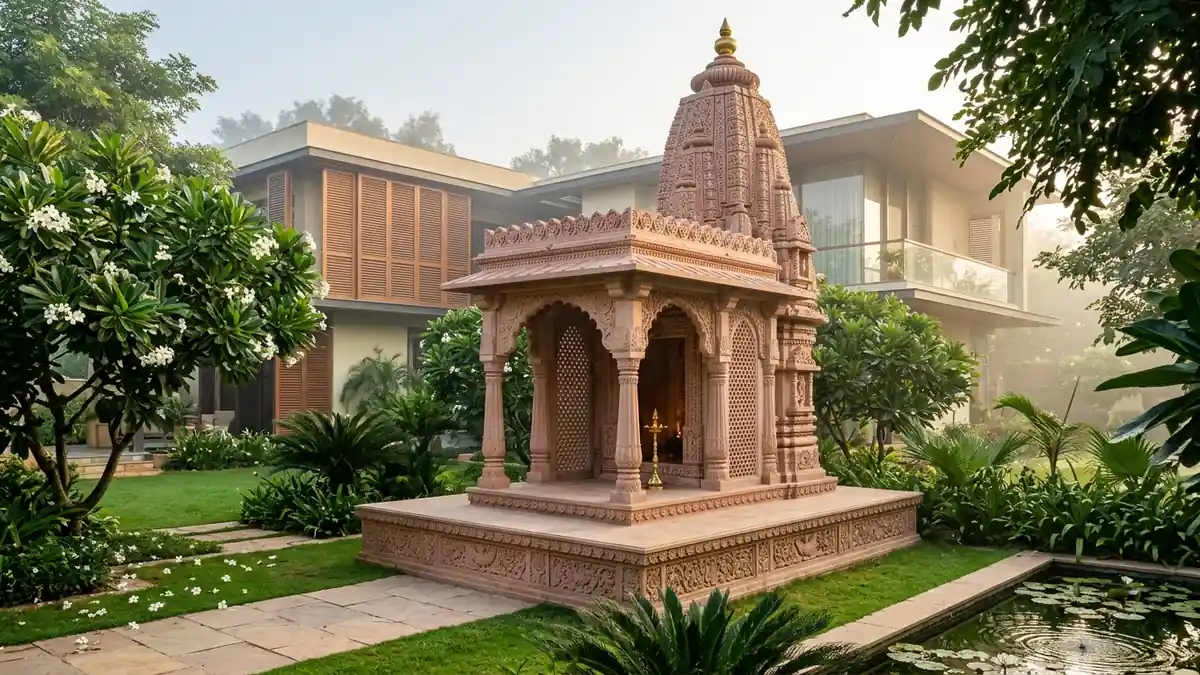
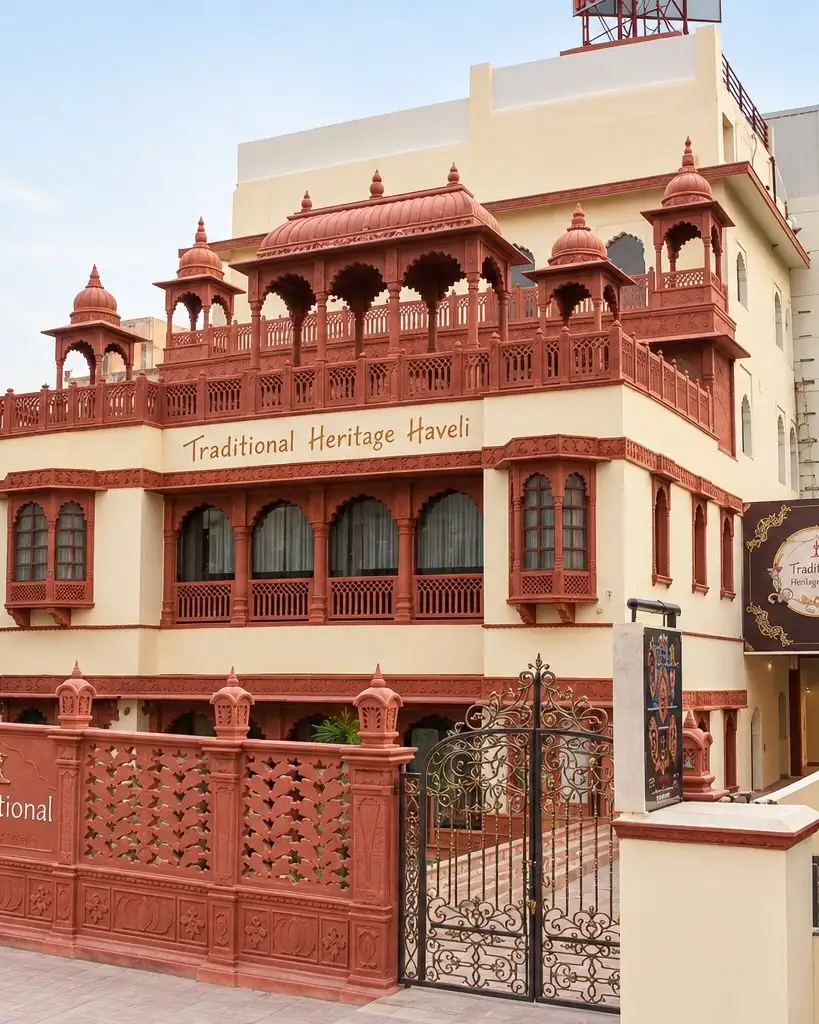
If the residence celebrates Indian roots with carved brackets (madals), cusped arches, courtyard colonnades, and intricate jaali balconies, Dholpur Red Sandstone, Bansi Paharpur Pink, and warm Jaisalmer tones bring unmistakable warmth. You can study authentic carved elements in our Heritage Facade Collection.
3. Integrating Carved Stone Jaalis for Daylight and Privacy
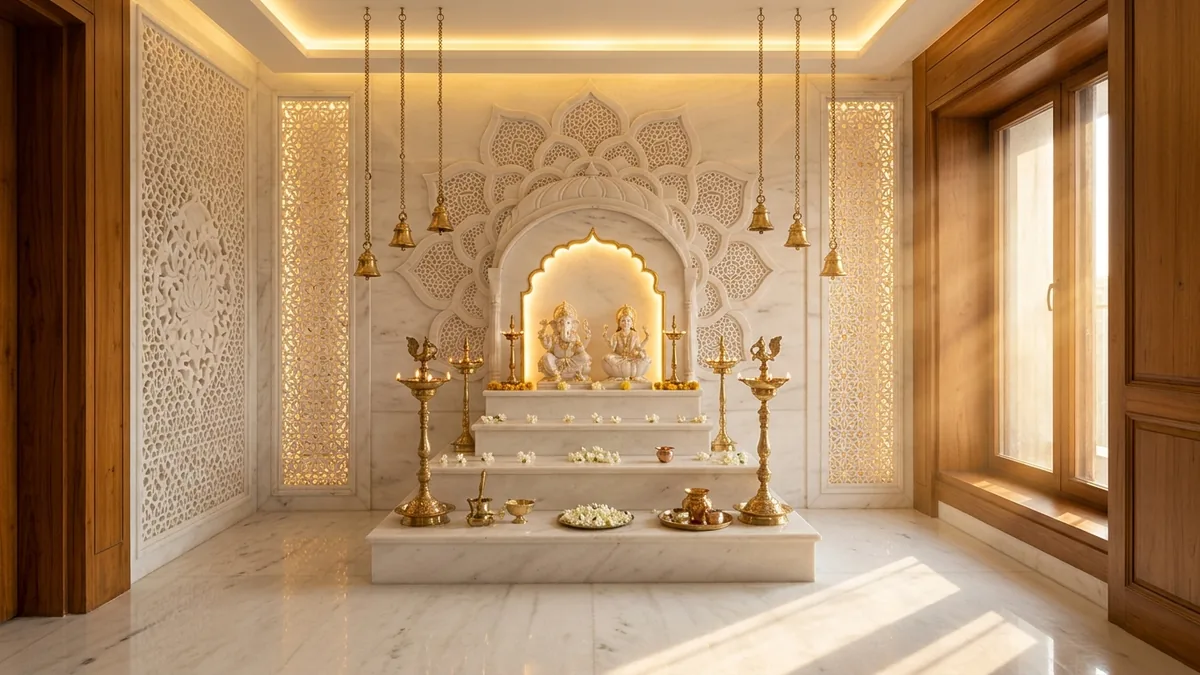
Tight urban plots often force windows to face neighbouring houses just ten feet away. Replacing heavy curtains with 40 mm to 50 mm thick CNC-and-hand-finished sandstone jaali screens lets fresh cross-ventilation pass into stairwells, double-height lounges, and verandas while blocking direct outsider sightlines during daytime.
As afternoon sun moves across the facade, geometric star, lotus, or hexagonal jaalis cast shifting lace-like shadows across interior floors, turning plain circulation corridors into dynamic light galleries. Pair facade screens seamlessly with custom designs from our Carved Stone Jaalis Collection.
Technical Stone & Design Comparison
| Sandstone Variety | Colour Palette | Recommended Slab Thickness | Signature Architectural Style |
|---|---|---|---|
| Dholpur Beige Sandstone | Warm cream, oatmeal & soft buff | 25 mm - 30 mm (Dry Clad) | Neoclassical villas, contemporary monoliths, fluted cornices |
| Dholpur Red Sandstone | Earthy terracotta & burnished rust | 30 mm - 40 mm (Dry / Masonry) | Heritage estates, institutional grandeur, haveli courtyards |
| Bansi Paharpur Pink | Soft rose-blush & warm salmon | 25 mm - 35 mm (Dry / Carved) | Rajasthani jharokhas, cusped arches, temple-inspired gateways |
| Teakwood / Rainbow Sandstone | Flowing golden-ochre woodgrain bands | 25 mm (Feature Walls) | Modern warm feature bays, entrance foyer accent walls |
Lifecycle Value: Natural Sandstone vs Exterior Paint
25-year architectural performance comparison on Indian villas
Repainting Cycles Saved
Eliminates scaffolding, scraping, and repainting required every 4-6 years with elastomeric paints.
Wall Surface Heat Drop
Ventilated dry-cladding air cavity blocks direct solar conduction into western bedrooms.
Anchor Steel Grade
Corrosion-proof mechanical pins engineered for wind uplift and seismic safety.
Weather Protection
Breathable hydrophobic treatment repels monsoon driving rain without trapping wall vapour.
Share Your Elevation CAD or SketchUp Model for Stone Take-Offs
We assist architects and villa owners with stone sampling, 3D moulding profiles, and dry-cladding shop drawings.
Frequently Asked Questions
What thickness of sandstone is required for dry mechanical facade cladding?
A minimum thickness of 25 mm to 30 mm is required for flat dry-clad sandstone panels so the 4 mm stainless steel kerf or pin slot has strong shear wall thickness on both sides without risk of cracking.
Does sandstone cladding turn black in heavy monsoon cities like Mumbai or Kerala?
Raw unsealed porous stone can hold moisture where airborne spores settle. Specifying a honed surface finish and two coats of breathable fluoropolymer or silane-siloxane water repellent prevents black biological growth even in coastal monsoons.
Can heavy carved stone jharokhas and cornices be added to an existing RCC frame?
Yes, provided an engineer verifies beam edge capacities. Instead of solid 2-ton blocks, contemporary jharokhas and classical cornices are precision-hollowed and assembled around structural stainless steel brackets bolted into RCC slabs and beams.
Which steel grade should be used for stone cladding clamps?
Always insist on certified SS-304 grade stainless steel cramps for inland cities, and marine-grade SS-316 stainless steel within 15 km of a coastline. Never allow galvanized iron (GI) or mild steel clamps, which rust and stain stone.