
Walk through a commercial slab yard and hundreds of stone sheets look interchangeable under showroom lights. Yet hand a random flooring block to a master sculptor with a tungsten-tipped chisel, and within ten strikes you find out why understanding the types of indian marble for carving changes everything. Brittle dolomitic stones shatter along hidden cleavage planes the moment an artisan attempts a delicate lotus stem or an open-fingered mudra.
India possesses some of the finest sculptural stone deposits on earth, quarried continuously across Rajasthan and northern Gujarat for over a millennium. Knowing how crystal grain size, calcium purity, and natural veining differ across Makrana, Ambaji, Banswara, and Bhainslana helps collectors and architects commission pieces with genuine heirloom value.
The four premier types of Indian marble for carving murtis, mandirs, and fine art sculptures are Makrana White Marble (98% pure calcitic endurance), Ambaji White Marble (creamy fine-grained softness for intricate figurative work), Banswara White Marble (expressive purple-grey veining for contemporary art), and Bhainslana Black Marble (dense jet-black stone for sacred idols).
- A good carving block ("stone without hairlines or quartz knots") represents less than 15% of total quarry extraction.
- Makrana White Marble hardens slightly on exposure to air and retains natural diamond polish without chemical wax coatings.
- Ambaji White Marble offers a buttery, fine-grained crystal structure prized for lifelike facial expressions on murtis.
- Bhainslana Black Marble from Kotputli, Rajasthan delivers authentic dark temple stone integrity without artificial black dye.
In This Architectural Guide
1. Makrana and Ambaji White Marbles for Sacred Detailing
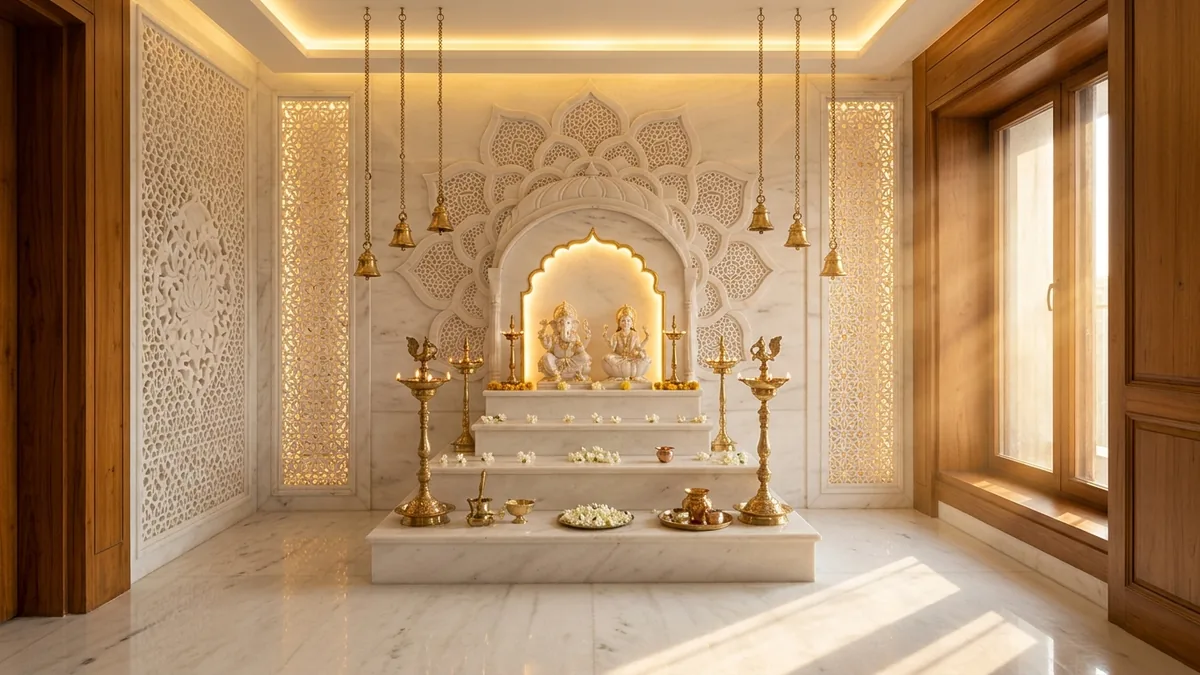
Makrana White Marble (specifically Sangemarmar Albeta and pure white grades from Nagaur, Rajasthan) is legendary because its interlocking calcite crystals contain up to 98% calcium carbonate with negligible iron. In temple pillars, backlit jaalis, and heirloom murtis, Makrana resists atmospheric dulling and never requires synthetic epoxy filling.
Just across the Gujarat border, Ambaji White Marble offers an ultra-tight, creamy milk-white grain with high plasticity under fine chisels. Master murti carvers favour select Ambaji blocks when sculpting intricate jewellery, crown filigree (mukut), and gentle, lifelike expressions on Radha-Krishna, Saraswati, and Ganesha idols.
Explore Hand-Carved Sculptures & Sacred Murtis in Authentic Indian Stone
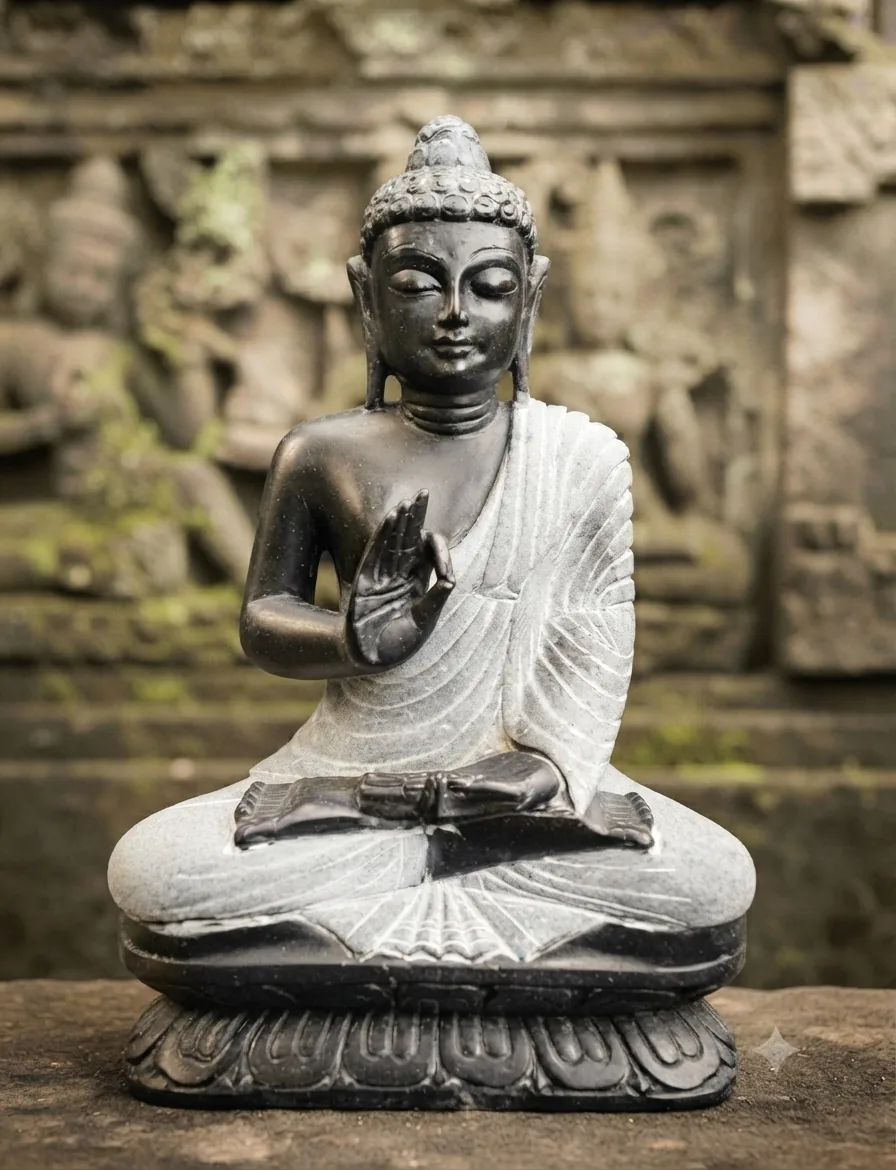
From serene meditating Buddhas in Bhainslana Black to contemporary Banswara marble forms, view our gallery.
2. Banswara White Marble for Contemporary Art and Furniture
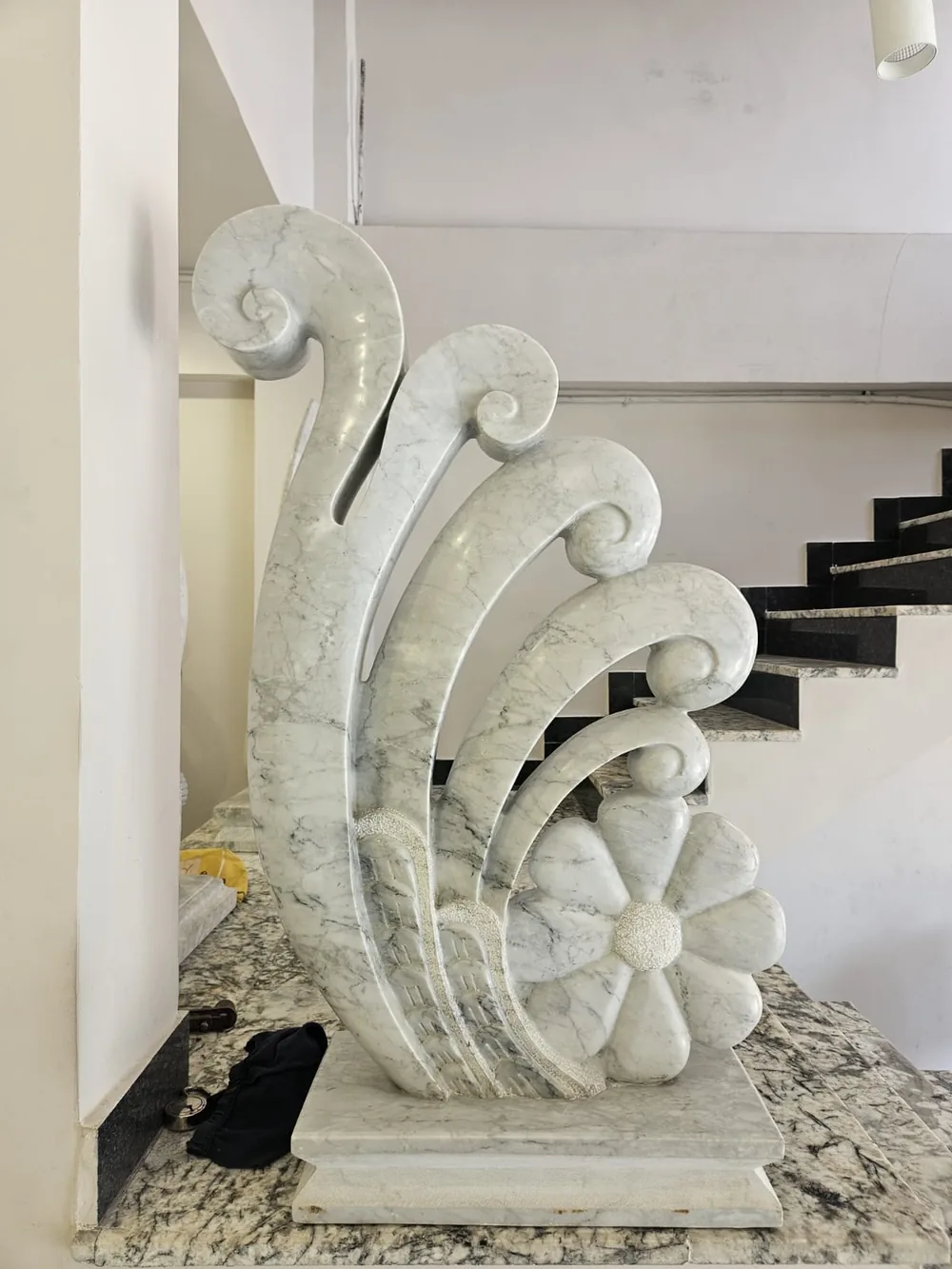
Where sacred idols usually call for unblemished uniformity so mineral lines do not cross a deity face, contemporary foyer sculptures, carved pedestals, and monolithic consoles come alive with natural movement. Quarried in southern Rajasthan, Banswara White Marble pairs a warm ivory base with graceful diagonal ribbons of misty grey, taupe, and subtle plum.
When shaped into flowing abstract loops, floral reliefs, or bubble-leg console tables, Banswara veining accentuates every curve, guaranteeing that no two commissions ever look identical. See finished gallery works in our Art Sculptures Collection.
3. Bhainslana Black Marble: Authentic Dark Sacred Stone
Quarried near Kotputli in Jaipur district, Bhainslana Black Marble is a dense, fine-grained dark limestone-marble prized across India for sculpting Shiva Lingams, Abhaya Buddha statues, Tirupati Balaji reliefs, and contemporary courtyard fountains. Unpolished chiselled areas read cool charcoal-grey, while diamond-honed surfaces turn deep, velvety black.
Buyers should beware of cheap porous grey stones coated in black shoe polish or chemical dye in unverified markets; dyed stones fade to blotchy grey within months of abhishekam washing. Genuine Bhainslana Black stone derives its depth purely from progressive water-grit honing and natural sesame or almond oil conditioning during traditional prana-pratishtha care. Compare full technical sheets in our Stone Materials Guide.
Technical Stone & Design Comparison
| Indian Marble | Quarry Origin | Grain & Colour Profile | Ideal Commission Type |
|---|---|---|---|
| Makrana White Marble | Makrana, Nagaur (Rajasthan) | Medium-fine interlocking crystal; luminous pure white | Heirloom home mandirs, carved jaalis, classical pillars |
| Ambaji White Marble | Banaskantha (Gujarat) | Ultra-fine buttery grain; warm milky ivory-white | High-detail deity murtis, delicate filigree & ornaments |
| Banswara White Marble | Banswara (South Rajasthan) | Fine grain; warm white with violet-grey flowing veins | Contemporary abstract sculptures, consoles, statement benches |
| Bhainslana Black Marble | Kotputli, Jaipur (Rajasthan) | Dense compact grain; charcoal raw to velvety jet-black honed | Sacred black murtis, Buddha statues, sculptural fountains |
From Rajasthan Quarry to Finished Sculpture: 4 Quality Gates
Why block-grade selection determines 100-year durability
Acoustic Hammer Ring Test
Rejects internally stressed blocks before rough-cutting begins.
Vein Orientation Mapping
Aligns block bedding planes so faces and delicate hands stay unblemished.
Hand Chisel Undercutting
Traditional shilpkar hand tools bring life and warmth that machine routers miss.
8-Stage Diamond Honing
Pure mechanical water-polishing from 60-grit up to 3000-grit natural lustre.
Commissioning a Custom Sculpture, Murti, or Architectural Piece?
Request physical stone sample tiles and speak directly with our curation studio about block selection.
Frequently Asked Questions
How can I tell genuine Bhainslana Black Marble apart from chemically dyed stone?
Rub a clean white cotton cloth moistened with a drop of acetone or lemon on an inconspicuous underside corner. Authentic honed Bhainslana Black Marble transfers zero black pigment onto the cloth because its dark tone comes from the natural mineral rock.
Which Indian marble is best for an outdoor garden sculpture?
Makrana White Marble, Banswara Marble in a honed matte finish, and Bhainslana Black Marble all perform reliably outdoors due to their low porosity, whereas mirror-gloss finishes are better reserved for covered foyers and interiors.
Why are carving-grade marble blocks priced differently from flooring slabs?
Flooring slabs are gang-sawn 18 mm thick and reinforced with fibreglass mesh on the back. A 3D sculpture block must be completely free of internal fissures across 18 to 36 inches of solid depth in every direction, making A-grade sculpture blocks far rarer at the quarry.
Can daily milk and water abhishekam be performed on white and black Indian marble murtis?
Yes. Both calcitic white marbles (Makrana, Ambaji) and dense Bhainslana Black Marble are traditional abhishekam-safe stones. Simply rinse thoroughly with clean water after milk, honey, or panchamrit rituals and pat dry with a soft cotton cloth.