
When families sit down with their architect to plan a new home, deciding on a marble vs sandstone mandir is rarely just a colour choice. A wooden cabinet pooja unit lasts ten or fifteen years before hinges loosen or veneer peels near oil lamps. A carved natural stone temple stays in the family for generations, holding the daily rhythm of morning bells, incense, and evening diyas.
Yet marble and sandstone behave very differently once installed. Put a high-polish white marble temple in an uncovered garden lawn and dust, bird droppings, and acid rain will dull its mirror sheen within three seasons. Put a raw, porous sandstone shrine inside a compact apartment alcove where haldi, kumkum, and ghee are offered daily, and cleaning oil splashes takes far more effort than it should. Understanding where your temple will sit and how your family performs pooja makes the material decision clear.
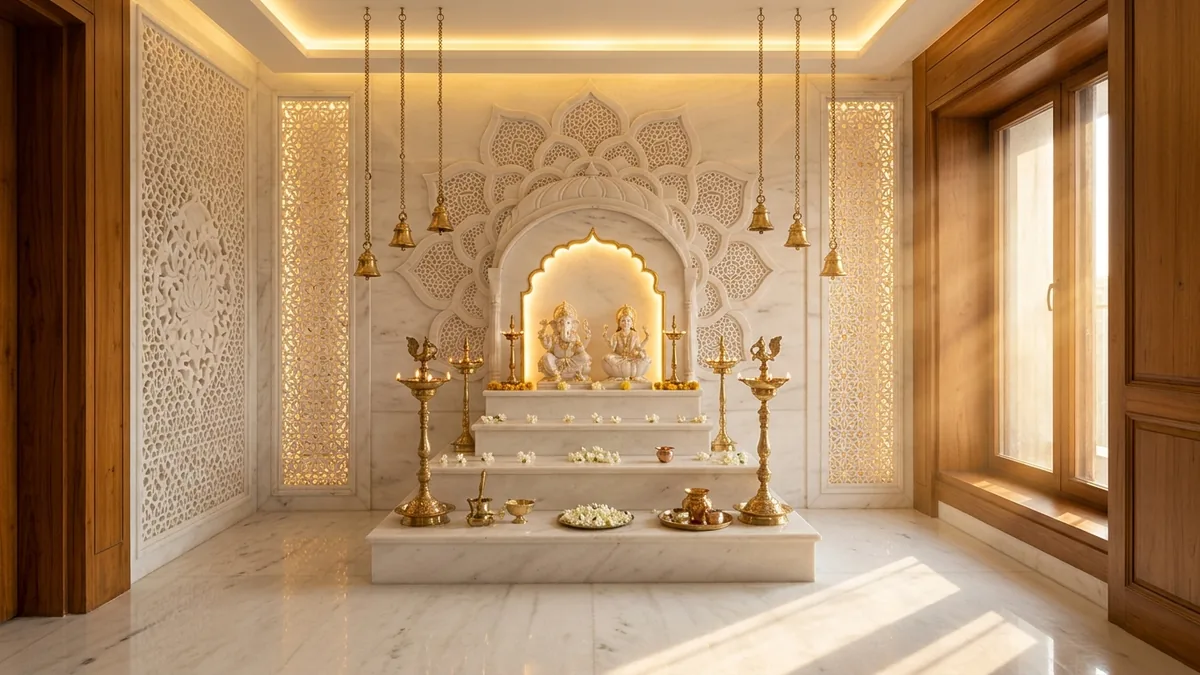
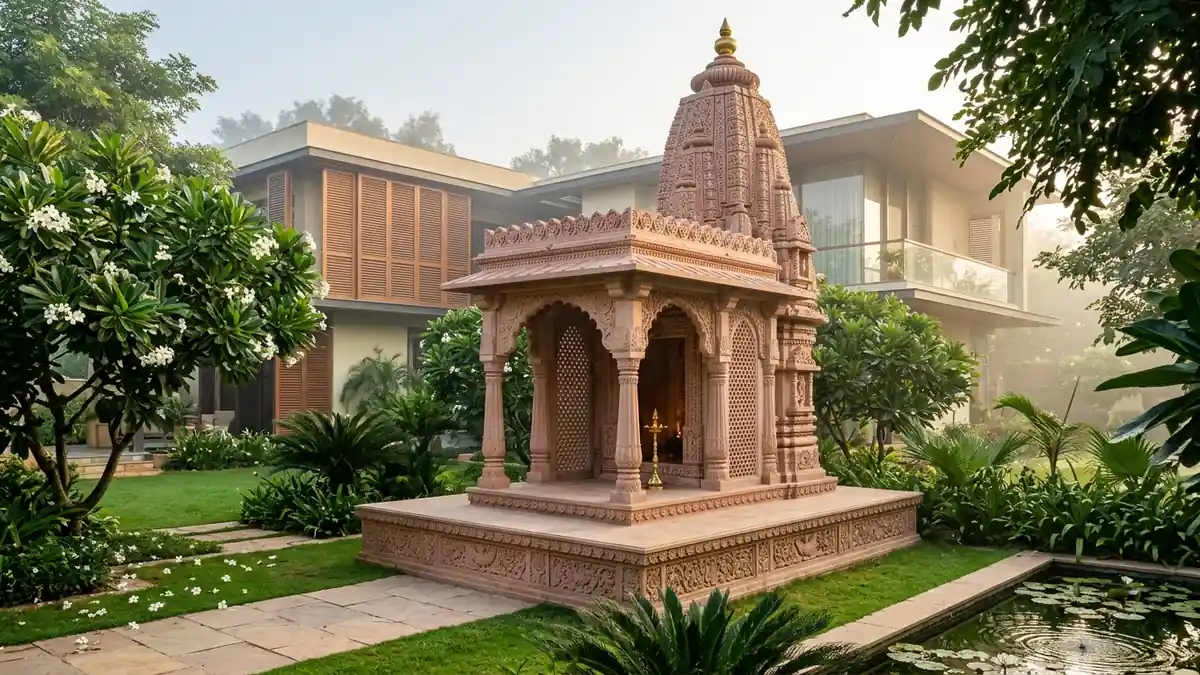
Choose a white marble mandir (such as Makrana or Vietnam White) for indoor pooja rooms where luminous light reflection, compact detailing, and easy wiping of kumkum or oil are priorities. Choose a sandstone mandir (Dholpur Beige, Pink, or Red) for outdoor courtyards, gardens, and farmhouses exposed to sun and monsoon rain.
- Makrana White Marble has near-zero porosity (under 0.4%) and 98% calcium carbonate purity, preventing yellowing indoors.
- Bansi Paharpur Pink and Dholpur Sandstones breathe naturally in open air, handling 45°C summer heat and heavy monsoons without hairline thermal stress.
- Daily aarti smoke, haldi, and sesame oil require honed or polished marble indoors, or breathable silane-sealed sandstone outdoors.
- Structural floor load matters: a 5-foot solid stone mandir weighs 350 kg to 650 kg and should sit near a beam or load-bearing wall in apartments.
In This Architectural Guide
1. How Indian White Marble Performs in Indoor Pooja Rooms
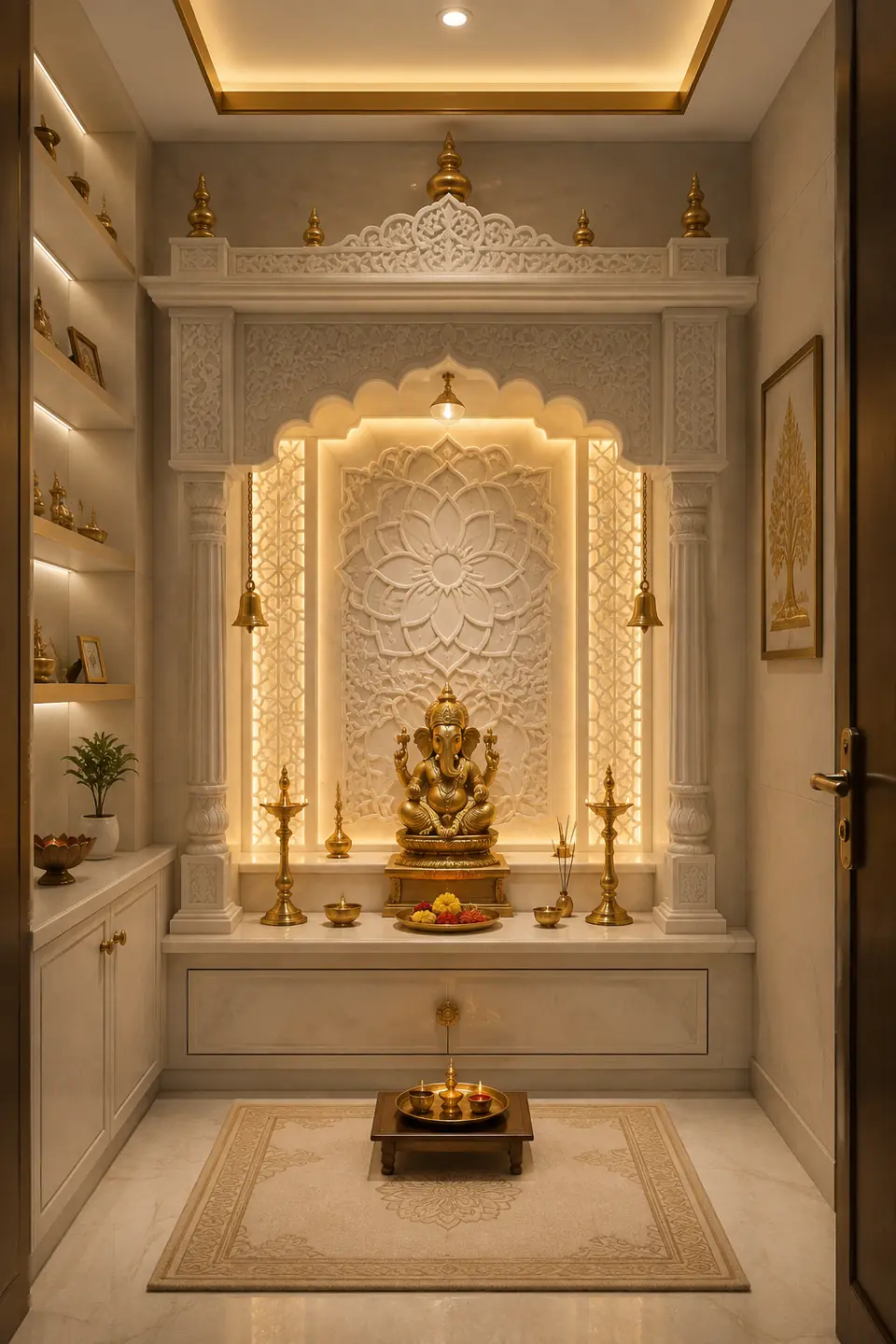
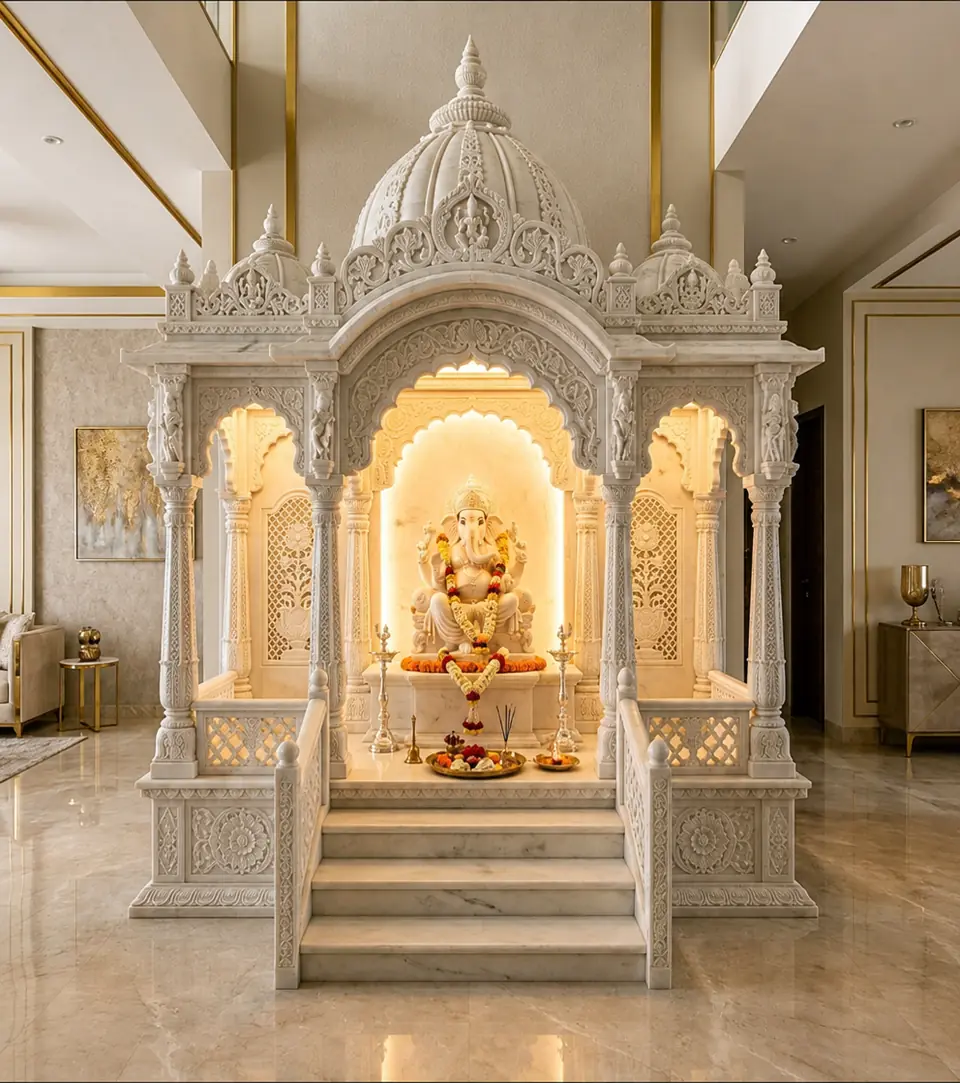
For dedicated indoor pooja rooms, double-height living room niches, and sunlit apartment corners, Makrana White Marble remains the benchmark across India. Quarried from the historic mines of Nagaur in Rajasthan, Makrana is a calcitic marble with interlocking crystal grains. Because its water absorption rate sits below 0.4%, liquid offerings like panchamrit, rose water, and chandan paste stay on the surface long enough to be wiped clean with a damp cotton cloth.
Architects also work frequently with Banswara White Marble (prized for gentle warm-grey and soft violet mineral waves) and pure fine-grain Vietnam White Marble when a homeowner wants a calm, uniform white backdrop for contemporary fluted or backlit mandala panels. Under warm 2700K LED cove lighting, white marble exhibits subtle subsurface translucency, giving carved lotus petals and peacock arches a quiet glow without harsh glare.
- Crisp Undercut Carving: Fine crystal structure allows artisans to carve delicate 4 mm jaali latticework, miniature kalash finials, and expressive pillar capitals without edge chipping.
- Fire and Diya Safety: Unlike engineered quartz or acrylic solid surfaces that scorch from resin binders, 100% natural calcitic marble handles brass akhand diyas safely when placed on a small brass plate.
- Cool Tactile Floor Presence: Sitting cross-legged on a marble plinth feels naturally cool during Indian summers while reflecting soft ambient daylight into compact rooms.
2. Why Sandstone Rules Outdoor Courtyards and Garden Temples
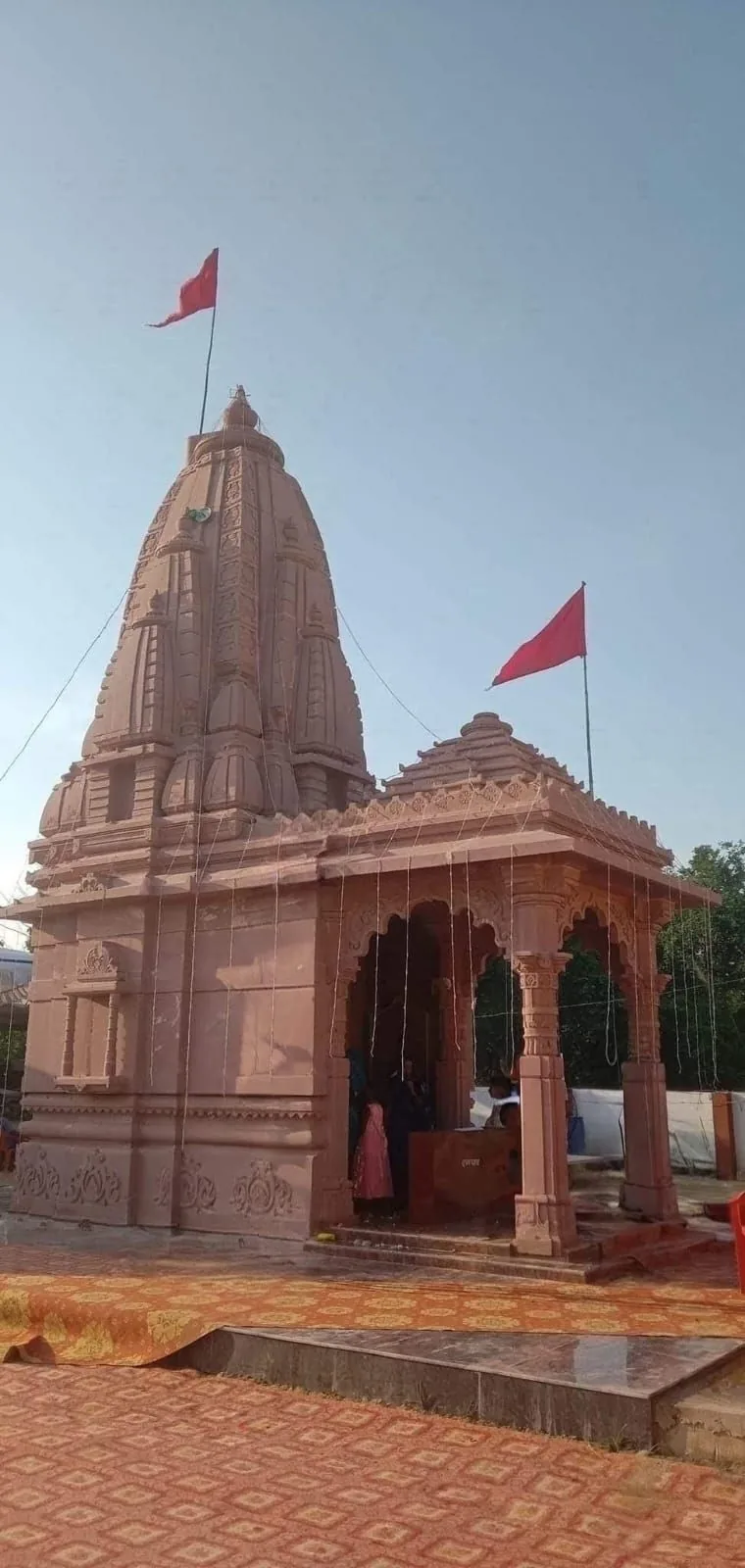
Step outside into a farmhouse lawn, central courtyard, or villa entrance garden, and the architectural rules flip completely. Traditional Nagara and Dravidian garden temples across Rajasthan, Madhya Pradesh, and Gujarat were built in Bansi Paharpur Pink Sandstone, Dholpur Red Sandstone, and Dholpur Beige Sandstone for a practical engineering reason: thermal stability and visual grace under open skies.
Sandstone is a sedimentary siliceous rock composed primarily of quartz grains. When summer afternoon temperatures cross 44°C followed by sudden monsoon downpours, sandstone expands and contracts uniformly without developing surface crazing. Over five to ten years outdoors, sandstone develops an authentic heritage patina that blends effortlessly with frangipani trees, tulsi vrindavans, and lush garden foliage.
Choosing Between Bansi Paharpur Pink, Dholpur Beige, and Dholpur Red
Bansi Paharpur Pink Sandstone carries a gentle lotus-blush tone prized for classical shikhara temples and elephant-pillar mandaps. Dholpur Beige offers a quieter, limestone-like neutrality suited to modern minimalist villas, while Dholpur Red delivers bold heritage gravitas ideal for large estate gateways and expansive courtyards.
You can browse handcrafted examples across both indoor and open-air settings in our Indoor Mandir Collection and Outdoor Mandir Collection to compare how carving shadow lines read in each stone.
See Custom Marble & Sandstone Mandirs Scaled for Real Homes
Browse traditional domed mandaps, minimalist fluted arches, and Nagara courtyard temples crafted to order.
3. Carving Depth, Shadow Play, and Architectural Style
In any marble vs sandstone mandir comparison, lighting determines how your eye reads the sculpture. White marble reflects light strongly, which means shallow relief carvings can sometimes wash out if hit by bright, direct overhead spotlights. To make marble carvings sing, master carvers use layered undercuts or pair a honed matte relief panel with warm Grazing LED strips.
Sandstone absorbs a portion of incident light and casts deep, velvety shadows inside every carved groove. Even from thirty feet across a lawn, the stepped geometry of a sandstone shikhara, carved bell pillars, and scalloped torana arches look crisp and three-dimensional in midday sun.
4. Structural Weight, Slab Load, and Installation Planning
Homeowners renovating high-rise apartments in Mumbai, Bengaluru, Delhi NCR, or Pune often worry whether their floor slab can hold a solid stone mandir. Both marble (density roughly 2,700 kg/m³) and sandstone (density roughly 2,300 to 2,450 kg/m³) are assembled using interlocking dry-fit and dowel-pinned modular sections: base plinth (peetham), carved columns, back jaali screen, and crowning dome or shikhara.
For apartments, a wall-flushed marble mandir with a hollow-cored plinth and 25 mm backlit carved jaali backdrop keeps total weight between 180 kg and 320 kg, well within standard residential RCC live-load tolerances when positioned along a perimeter wall. For independent bungalows and outdoor gardens, a dedicated concrete PCC footing prevents soil settlement during monsoon months. You can inspect individual stone specifications in our Natural Stone Materials Library before locking dimensions.
- Apartment Niche (3 ft to 4 ft wide): Modular Makrana or Banswara White Marble mandir; 180-320 kg distributed load; 1-day clean indoor assembly.
- Villa Pooja Room (5 ft to 7 ft wide): Full pillared marble mandap with garbhagriha step and carved ceiling dome; 450-850 kg; coordinated during flooring stage.
- Garden or Courtyard Shikhara Temple: Interlocking Bansi Paharpur or Dholpur Sandstone blocks on a raised 18-inch RCC plinth; weather-sealed with breathable penetrating silane sealer.
Technical Stone & Design Comparison
| Parameter | White Marble Mandir (Makrana / Banswara) | Sandstone Mandir (Bansi Paharpur / Dholpur) |
|---|---|---|
| Ideal Placement | Indoor pooja rooms, living niches, covered foyers | Outdoor gardens, open courtyards, farmhouse lawns |
| Water Absorption | Very Low (0.2% - 0.5%) | Moderate (1.5% - 3.5%, sealed before installation) |
| Oil, Haldi & Kumkum Care | Wipes clean easily on honed or polished finish | Requires breathable impregnating sealer to prevent soaking |
| Weather & UV Resistance | High polish dulls outdoors over time | Outstanding UV, 45°C heat, and monsoon endurance |
| Carving Aesthetics | Luminous, fine filigree, glowing backlit jaalis | Deep architectural shadows, bold heritage shikhara lines |
| Vastu Colour Alignment | Pure white suits North-East (Ishanya) serenity | Warm pink, cream, and ochre ground East & courtyard zones |
4-Step Sacred Stone Specification Blueprint
How Ishatva architects match stone variety to your home layout
Audit Sky & Rain Exposure
Select marble for climate-controlled interiors; select quartz-rich sandstone for sun and rain.
Verify Floor Load & Plinth
Modular dowel-pinned stone components distribute weight safely on apartment beams or garden footings.
Proportion Idol to Garbhagriha
Ensure shikhara or dome height respects seated eye-level darshan and Vastu sightlines.
Specify Surface Protection
Natural diamond polish on indoor marble; breathable hydro-oleophobic sealer on outdoor sandstone.
Planning a Pooja Room or Courtyard Temple?
Share your floor plan dimensions and site photos with our design studio for stone samples and proportional 2D/3D drawings.
Frequently Asked Questions
Which stone is best for an indoor home mandir according to Vastu?
Makrana White Marble and Vietnam White Marble are the top choices for an indoor home mandir in the North-East (Ishanya) corner. White symbolises purity, peace, and sattvic energy while reflecting soft diya light into the room.
Can we place a white marble mandir in an open garden or terrace?
If the terrace or courtyard has a deep overhead roof protecting the temple from direct rain and dust, honed white marble performs well. For completely open-to-sky gardens, Bansi Paharpur Pink Sandstone or Dholpur Beige Sandstone ages far better without losing its surface finish.
Does Makrana marble turn yellow over time near oil diyas?
Genuine Makrana White Marble contains roughly 98% calcium carbonate with minimal iron content, so the stone itself does not turn yellow. Any warm residue from ghee or incense smoke sits only on the surface and wipes off easily with mild soap and water.
How do you prevent moss on an outdoor sandstone mandir during monsoon?
Before handover, outdoor sandstone temples are treated with a breathable, UV-stable silane-siloxane penetrating sealer. Water beads off the carved shikhara grooves instead of soaking in, preventing green algae or moss buildup during humid monsoons.
How long does it take to hand-carve a custom stone mandir?
A compact 3-foot to 4-foot indoor marble mandir typically takes 6 to 8 weeks from drawing approval, while an intricate 7-foot pillared mandap or outdoor shikhara temple takes 10 to 16 weeks depending on carving density.