
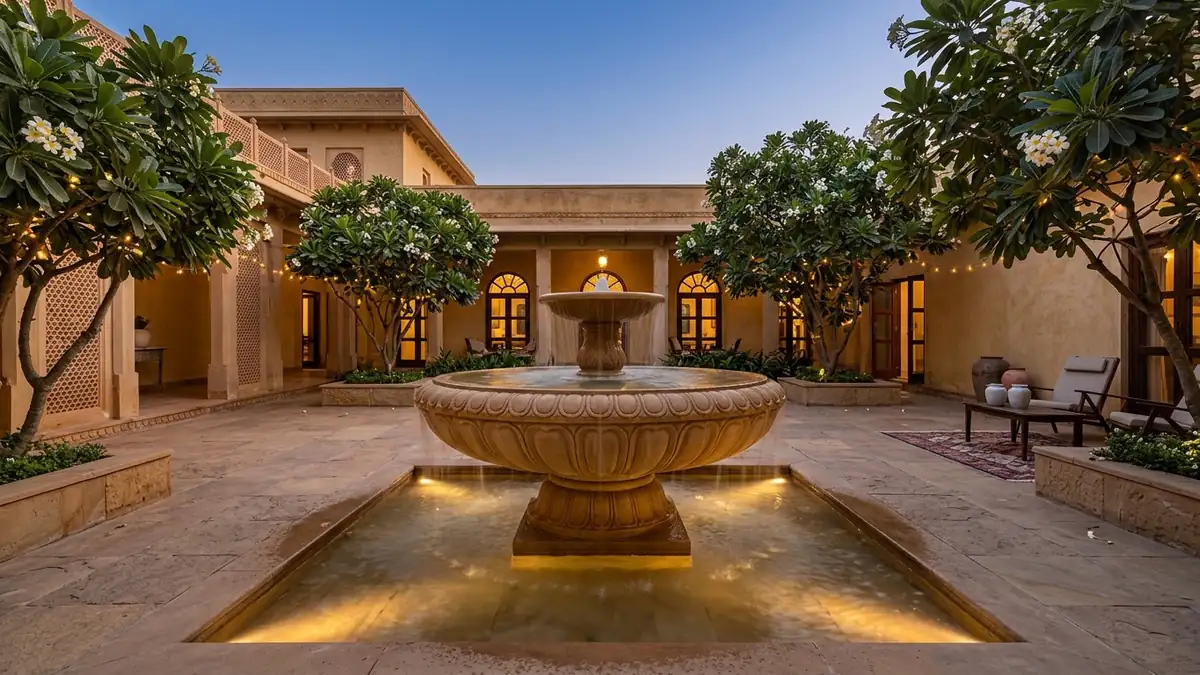
Planning a bespoke stone water fountain for courtyard farmhouses takes more care than simply dropping a stone bowl in the center of the lawn. Open courtyards in Indian homes get very hot during summer afternoons and create loud echoes across long verandahs. At the Ishatva stone studio and Stone World stone experience center in Indore, our stone carvers shape single-block sandstone water fountains that naturally cool the warm air and make a gentle water sound that covers up noisy traffic from nearby roads.
Table of Contents
Why Farmhouse Courtyards Need a Central Stone Water Feature
Traditional Indian architecture has placed water bodies at the center of residential chowks for generations. In large weekend farmhouses and countryside estates, open courtyards often trap heat like an oven in May and June. Adding a gentle fountain keeps water moving continuously, cooling the surrounding verandahs by three to five degrees as warm air rises and draws cool breeze inside.
Without water, a wide courtyard surrounded by glass doors, lime-plastered walls and stone floors acts like a loud sound box. A well-planned carved sandstone water body creates a gentle background murmur that absorbs sharp echoes, noisy orchard winds and highway vehicle sounds.
When architects discuss courtyard layout plans for luxury homes, four fountain layouts work best.
- Central Chowk Fountains sit in the traditional Brahmasthan center with an octagonal carved basin and lotus-shaped urn.
- Long Reflection Pools align in front of living room glass doors, giving a clean water mirror view from inside the house.
- Wall Spout Fountains fit narrow courtyard walls using carved stone spouts that drop water into a ground stone trough.
- Sunken Seating Water Bowls wrap around outdoor family sitting areas, acting like a cool moat around sunken sofa steps.
Which Indian Natural Stone Is Best for a Courtyard Water Fountain?
Picking stone for an outdoor fountain means choosing rocks that can handle hot sun and water immersion without peeling or turning soft. Weak stones drink too much water and develop cracks during winter, while high-iron stones leave red rust streaks on white floors.
Mined in Rajasthan, authentic Dholpur beige sandstone is the classic stone for carved lotus bowls because its fine quartz grain lets artisans carve sharp, scalloped petals that let water glide over without chipping.
For modern water walls with natural grain patterns, Khatu teakwood sandstone carries warm golden bands that look like real timber and turn into rich honey shades when wet.
For the bottom of reflection pools, dark Marine black marble from Kotputli and dense Rajasthan black granite stop dirt marks completely, giving a clean mirror surface that reflects trees and clouds.
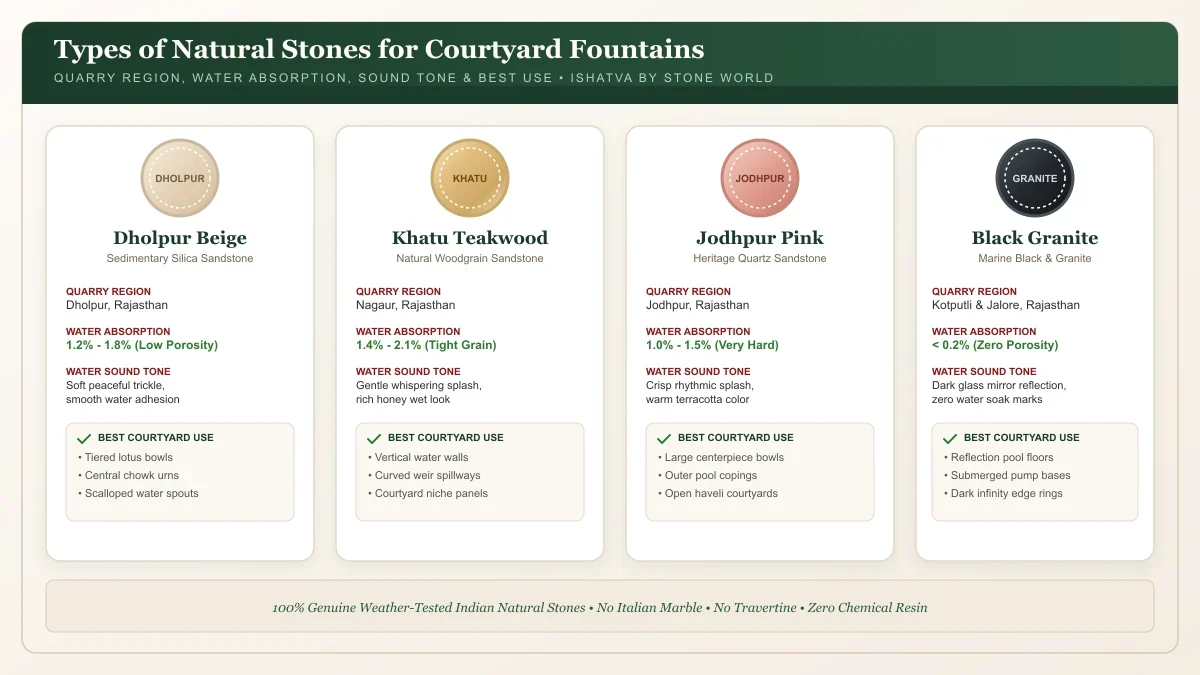
| Natural Indian Stone | Quarry Region | Water Absorption % | Sound Quality | Best Courtyard Water Application |
|---|---|---|---|---|
| Dholpur Beige Sandstone | Dholpur, Rajasthan | 1.2% - 1.8% | Soft peaceful trickle | Tiered bowls, lotus spouts and central chowk urns |
| Khatu Teak Sandstone | Nagaur, Rajasthan | 1.4% - 2.1% | Gentle whispering splash | Water walls, curved weirs and courtyard niche backdrops |
| Jodhpur Pink Sandstone | Jodhpur, Rajasthan | 1.0% - 1.5% | Crisp rhythmic splash | Large centerpiece bowls, perimeter copings and main basins |
| Marine Black Marble | Kotputli, Rajasthan | Under 0.3% | Dark glass mirror slide | Reflection pool floors and dark infinity edge overflow rings |
| Rajasthan Black Granite | Jalore, Rajasthan | Under 0.15% | Solid impact sound | Underwater plinths, pump concealment vaults and basin bottoms |
How to Control Water Fall Sound in Courtyards
The sound of your fountain can either make your farmhouse feel peaceful or create a noisy echoing space. Sound bounces easily off brick walls and glass doors. When water drops from more than two feet, the splash is so loud that you cannot talk easily on the verandah and tiny water droplets blow onto dry floor tiles.
Setting up an outdoor sculptural fountain requires careful control of water height, spillway curve and pool depth. A gently curved lotus bowl lets water cling to the stone body before sliding smoothly into the lower pool, stopping noisy splashing.
Our stone carvers shape miniature grooves along the edge of our architectural stone water features, breaking heavy water sheets into soft stream ribbons that touch the pool surface quietly.
Practical Sound Rules for Courtyard Fountains
- Keep water drop height between 150 and 250 millimeters for family courtyards under forty square meters.
- Aim for a quiet 48 to 52 decibel sound level, matching a comfortable speaking voice indoors.
- Keep pool water at least 200 millimeters deep so falling water hits deep water instead of bare stone bottom.
- Use wide low dome bubblers instead of tall high-pressure spouts that spray everywhere in the wind.
- Cut a small groove under stone lips so water drops straight down instead of dribbling back along the stone pillar.
Pump Setup and Hidden Underground Water Pipes
Nothing looks worse in a luxury stone fountain than black electric wires, loose plastic pipes and a vibrating water pump sitting right in the carved bowl. Good planning keeps all the motor machinery hidden away.
Water simply overflows from the carved fountain bowl into an invisible drain channel, flowing through underground pipes into a small brick pit built inside a nearby garden bed. This pit holds the submersible pump, leaf filter basket, automatic float valve and cleanout drain.
With this setup, when servicing a sculptural water fountain, your plumber simply lifts a stone lid in the garden to clean the filter, without ever stepping into the main stone reflection pool.
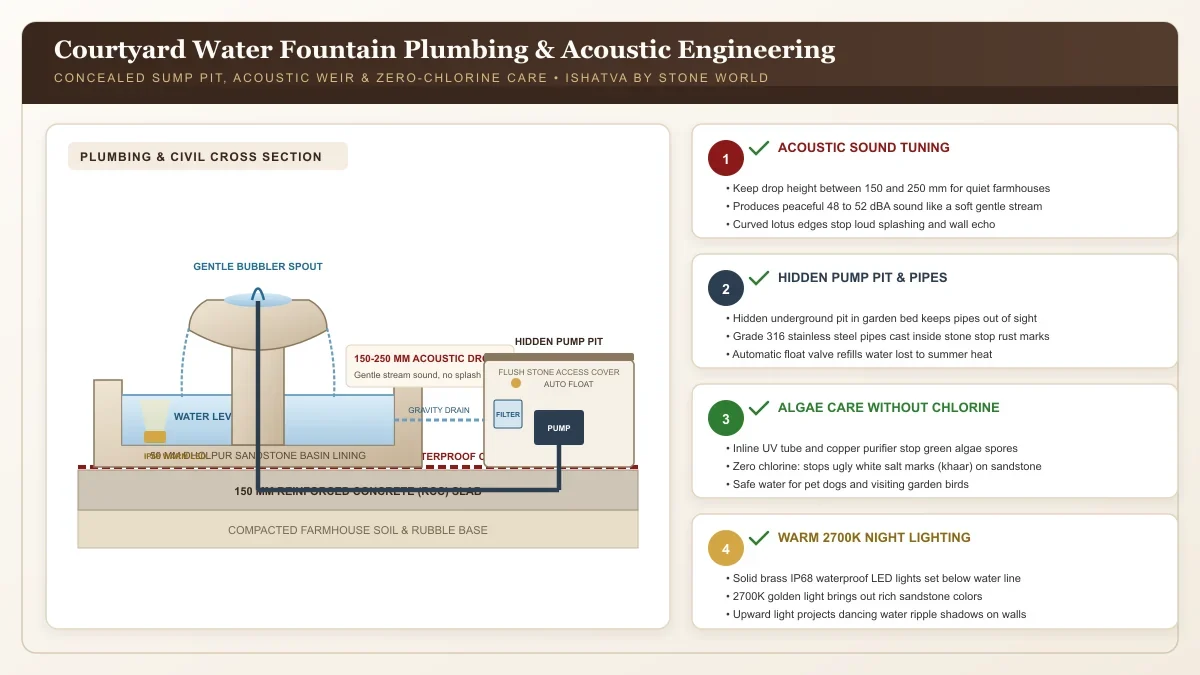
Always run Grade 316 stainless steel or heavy CPVC pipes through the center of the stone pillar during workshop carving to avoid hidden leaks later.
Concrete Foundation, Waterproofing and Stopping Green Algae
Farmhouse soil gets soft and muddy during rainy months. A solid stone fountain weighing two tons or more will tilt or crack if placed directly on soil or loose sand. A dedicated 150-millimeter reinforced concrete (RCC) foundation slab with steel mesh gives total safety.
Waterproofing needs two solid layers. Coat the concrete foundation with two coats of flexible elastomeric waterproof coating before fixing the stone. Use waterproof stone epoxy to seal all stone joints so water never leaks into the ground.
Keeping water clean in hot Indian weather requires care. Never use swimming pool chlorine in a luxury villa landscape water feature because chlorine attacks natural sandstone, turns warm beige colors into patchy white blotches and leaves chalky salt marks (shora or khaar) on fine carvings.
Instead, fit an inline UV-C clarifier tube and copper mineral purifier in the pipe line. The UV light kills green algae spores while copper keeps the water crystal clear, completely safe for pet dogs and visiting birds to drink.
For more maintenance advice on natural stone in outdoor gardens, see our carved stone water bodies portfolio and care guide.
Warm Night Lighting and Water Ripple Reflections
A stone fountain looks completely different after sunset. Bright white floodlights make warm sandstone look cold, dull and flat, while creating harsh glare on the water. Warm 2700K golden light brings out the rich yellow and pink tones of Dholpur and Jodhpur sandstone.
Place waterproof IP68 brass lights under the water, pointing up toward the carved bowl. As water ripples cross the stone rim, the light throws gentle moving wave reflections onto surrounding verandah walls and stone jali screens.
Pair fountain lights with ground-level pathway lights from our stone lamps and lighting collection for a peaceful nighttime courtyard feel.
How Long Does It Take to Make and Set Up a Custom Stone Fountain?
The cost and time needed for a custom courtyard fountain depend on stone block size, carving depth and crane placement on site rather than simple square foot rates.
The biggest factor is whether the bowl is carved from one single giant rock or assembled from stone petal pieces. Carving a bowl from one solid rock requires mining a huge unblemished boulder with lots of wastage to hollow out the center, while petal sections use smaller stones joined with concealed steel pins.
Hand-carving fluted lotus petals and smooth spillway edges takes hundreds of hours of patient chisel work. Before packing, every fountain is assembled and tested with running water in our workshop to check that water flows evenly on all sides.
Visiting our bespoke architectural stone studio lets you inspect raw quarry blocks, review 3D pipe models and see sample carvings before workshop carving begins.
Why Check Real Water Flow at the Indore Experience Center?
Phone photos and 3D computer drawings never show how real water wets sandstone and how natural veins darken in sunlight. Visiting our experience center in Indore gives architects and homeowners direct access to full-scale working water mockups.
Visit the Ishatva & Stone World Experience Center in Indore
Inspect operating stone water features, evaluate acoustic weir profiles and discuss your bespoke farmhouse courtyard plans with our team.
Frequently Asked Questions
How do you stop a courtyard stone fountain from splashing onto verandah floors?
Keep water drop heights under 250 millimeters, carve curved fluted spillway weirs that guide water sheets smoothly and maintain a surrounding basin rim setback of at least 600 millimeters from the splash zone.
Does continuous water flow cause green algae stains on sandstone fountains?
Algae thrives only when water sits stagnant under direct sunlight. Circulating water continuously through an inline UV-C clarifier and applying a breathable silane-siloxane stone sealer prevents organic spores from penetrating sandstone pores.
How do you service the fountain pump without emptying the stone water pool?
Install the submersible pump inside an external concealed underground sump pit connected by gravity pipes rather than placing it in the decorative stone bowl. This allows filter cleaning and pump maintenance without draining the main basin.
Can swimming pool chlorine be used in a natural sandstone fountain?
Never use chlorine in natural sandstone fountains because chlorine chemically reacts with natural mineral binders in the stone, creating white efflorescence salt crusts and etching delicate carvings. Use mineral copper purifiers instead.
How do you handle rapid water evaporation during hot summer months?
Fit an automatic mechanical or magnetic float valve inside the concealed sump pit connected to the estate fresh water line. The valve automatically replenishes evaporated water to prevent the pump from running dry.
How long does it take to design, carve and install a bespoke courtyard stone fountain?
A custom fountain requires eight to fourteen weeks from 3D hydraulic CAD approval to on-site assembly, including monolithic quarry block extraction, artisan hand chisel work, workshop wet testing and site craning.